Poppy Wilcox. I will be posting pictures and videos of my lessons. It will show that I understand what we are doing as I say what we did, how we did it, and why we did it. Enjoy.
Working with the members of N2C, Mr Chipp commissioned us to set work on directing some performances which we would then showcase to a public audience. Myself and Kelly decided to pair up as we have a knowledge that our desire of a performance to look is very similar.
It was then agreed that the stimulus of our pieces were to be the Grimm's Tales, we had the book with the collection of the Grimms Brothers stories and dramatisations. When looking through these I felt the one I had the most idea's for was 'Little Red Cap'. This is from my previous knowledge of finding out the discovery of the darker version of Little Red Cap, and the underlying sexual meanings of how woman should not stray from the path, the depiction of the aggressive male, and the cloak being a symbolism of womanhood. It was from this that I began to do my work researching before the first session with the group that Mr Chipp choose for me.
I began looking at other dramatisations of Little Red Cap for inspiration and came across a few.
'Big Bad Wolves'( http://vimeo.com/769224 ) is a comedy deciphering the underlying messages of the the story and highlighting the flaws that were adapted in to making it less realistic and more accessible as a fairy tale with a moral for young children. I wanted to take these aspects and use them in my performances to make it more shocking for the audience.
http://www.youtube.com/watch?v=WH_llv6IWKM after watching this video that included no speaking, I thought that the silhouette effect gave a very eerie effect and this inspired me to use an aspect of shadow theatre at some point in my piece, perhaps in sections where I want to remove a cliché expectation of the familiar story.
I also looked at the musical 'Into The Woods' by Stephan Sondheim, and was really inspired by his use of music to reflect the emotions of the characters and bring out some of the subtext. It is this rhythm that I wanted to adapt into my own performance to give it fluidity and engage the audience by having phrases that become more memorable from the rhyming and rhythmic aspect.
After doing this research I decided to create a workshop for the first session, this is a vlog reflecting on the workshop and how it went:
This day we were adding the first piece of debate is the scene in which a Government Army guard is here to escort the Photographer and Journalist from the area. We wanted this scene to be fast pace with high energy serious scene. This will pick up the pace of the overall performance as the last scene is the Journalist reading the story, which is very low energy. By placing a high impact scene we will be able to hold the attention of our target audience of secondary school. We needed to return the Photographer back into the room so continued the humor &had a small scene in which they attempt to return the used tissue back to the Journalist. They go on to discuss the story and here's where the first bit of conflict takes place.
I worked with Matt to create a scene where he asked for which story I was going to use which would cause tension as he doesn't have the correct photo's for the story in which the Journalist wanted to use. By doing this we can see a work disagreement that is caused by the emotional connection the Journalist has made about the story needing to present the whole truth. This disagreement is disrupted by a large bang from outside which represents the war zone outside. This is when the Army Guard appears by knocking on the door. To open the door we opened it cautiously. When he entered he told us to pack out things to go, we made him connect to the outside war zone by opening the window and being ready to shoot.We created more violence in the scene by making the Army Guard grab the Photographer which gives a higher impact and more hectic feel to the scene. The debate between the Journalist and the Photographer here was that the Photographer wanted to stay and record this story and aims to persuade the Journalist to stay. They come together as a team to tell the Army Guard a new plan to meet them in two days instead. This is where the Journalist takes charge, and because the Photographer has to persuade the Journalist is shows who holds the most power between the two. While the Army Guard is present, the next piece of conflict is presented when there is a knock on the door. At first we decided that we should act as if it was a rebel which would create a bigger juxtaposition when the door opens to reveal a child. We decided that with the previous scene in which P & J over the photo matching the story that the Journalist has developed a connection with these war surroundings. This is why the Journalist removes the aim of the Army Guard's gun to provide a kinder hand to check the child is unarmed. This scene presents one side of the harsh world that is going on outside the Journalists room, by doing this we bring a contrast of the safe world that the audience has been allowed to see, and stepped it up with the intimidating soldier figure. We also got to see more of the Photographer and Journalists character when presented with conflict. We used the same process of creating two different approaches and blending the best parts, such as the comedy at the knock of the Army Guard in order to make a short relief between two serious scenes.
The cast was split into two group, I was working with Chris and Alex. He gave us the square piece of wood and told us to create as many ways to get around these piece of wood. We tried to create a variety of ways, but most were using a rotational action that would be controlled by Chris and me and Alex would move the piece of wood corresponding to how Chris manipulated it. After creating a small sequence we were told to relate this to the war zone. We liked the idea (as we knew the square was actually representing a door) that every time Chris came out one side, he'd want to hide from what he was witnessing. This meant we could develop some moves and actually came up with an idea that we shut him in the 'bad' side and he climbs over. Instead of it always being the door manipulated by Chris, me and Alex held the door down so that Chris had to lift himself over the top of as if he was climbing over a wall, during this transition we made him into one of the people living in the war zone as he then got shot. We then laid him on the door and rolled him off as if he was a discarded piece. We were then given the prototype door, it was very big and much heavier. This helped us to take into consideration what the real door would be like, as that one would have a steal frame. We took out as little as we could from our sequence and tried to adapt the moves with the new challenge of the door. It was challenging to put the story across so we made sure that Chris carried it most of the stories feelings so me and Alex could focus on leaving the right amount of times for pauses as well as keeping the flow of it smooth in connection to Chris' movement. Emily, Kelly and Matt then showed us their sequence and we showed us ours. We had a certain amount of time to teach each other our sequences we required a lot of attention and focus, I felt I was quite strong at remembering what the other group had done just from performing to us. After this we separated again and cherry picked our favourite parts of each other's sequences. We then further adapted our piece by adding our favourite parts from their's and the parts that were the strongest from ours. By doing this we had a sequence that was not only a lot stronger, but was able to carry a lot more of the story that was necessary. We still felt our final part of the sequence where it looks like we're shoveling off a dead body was a good way to be able to link the sequence back to the start.
It was nice to take a break from the naturalistic acting and look into the what will be the physical theatre opening sequence that is to show a glimpse of that world and previous experiences of the Photographer and Journalist before the point the performance begins.
We decided that the next scene the performance would be to have the Journalist read a speech that would switch the atmosphere to a more serious tone and explain most of the war situation. Mr Chipp gave us the first part of the speech, and then told us he wanted us to continue the report in the same style with a story in which we researched. The start of the speech was this:Since checks file July 2010 the regime has systematically and brutally repressed, silenced any and all opposition. The rebel…corrects self… Anti-government forces have used this brutality as a justification for their own ferocity and despite the furrowing of international brows the UN seems to be implicitly in agreement by the inaction's and silence: the ends justify the means.
We spent a while looking at the stories on the War Child page as we all agreed that the stories that would get the attention of the audience were about children younger than themselves. There were a variety of horrific events that were chosen. Some included rape, a father carrying their dead child, post traumatic stress humiliation.
We all performed these speeches with a reporter tone, I held a pen in my hand and throughout my speech made corrections as if I were proof reading. We also had to show more emotion as the story got to us near to the end of the speech.
Once everyone had performed there speeches, we tried to settle on a story that we all felt connected with us the most by being so emotionally scaring. These were the stories of rape and the father carrying the dead child. We had a debate about which the journalist would choose to write about and came to the decision that although the rape story is still horrific, the father and child story had a strong imagery that the Journalist would then be able to describe in more detail in her article.
After doing this, we all wrote a monologue of the same story and were able to workshop these with the other cast members. As the Journalist character is moved emotionally by the story we were able to add this into account when thinking of their characteristics. We liked the reformulation of the speeches, it gave a real sense of a reporter style that made the character seem like she was very used to depicting these stories to a dictaphone and we were able to put in subtle hints about what is politically correct to say.
Four out of the six of us decided to embark on the marketing unit: myself, Matt, Chris and Emily. Together we were commissioned to create a promotional outlet for the drama company ran by Mr Chipp called 'N2C' - which stands for no to conflict. This company aims to use drama to raise awareness of local conflict issues and then perform them to public or specific audiences.
We looked at a variety of ways in which we could focus our efforts to pull in more budding thespians. We considered leaflets, flyers, posters but none of these seemed to be a great enough outlet that we could put all our information on. We decided that the best way to reach out to a teenage generation and their parents is through the internet. We decided that a website would be the best and then anything else that the client desired we would also create. Luckily, this is exactly what our client had in mind and we were asked to create a website and a flyer that promote N2C and a leaflet for the upcoming production from N2C 'Open The Door' Mr Chipp asked us to produce the bear bones of a website that promoted the company and let others know how to participate as an N2C member. He also asked that we create an idea for a two fliers so that post-unit we could develop the promotion of the 'Open the Door' project that N2C is starting as well as promoting N2C itself.
Target Audience: We want to attract teenagers age 14 - 20. This is because some of the work that N2C do is hard hitting and therefore the company members need to have a level of maturity and understand to develop performances with the correct attitude. We must also remember that parents will be view the website once the child is interested and therefore must not create an informal tone for sake of attractracing teenages, but maintain a professional standard to replicate the standard of the company.
Together, the four us came up with bullet points of initial idea's that would create the basics of the website, such as:
- we want the house style of the website to follow red, black, white (the same as the current N2C logo's) - the font that is used for the logo to also be replecated throughout the website for continuity. - use a variety of images to show the versitality and wide variety of performances the company try to acheive to percieve a unique drama company Throughout the group we all had separate parts to focus on,
As Matt was doing the computer development (as he has the most technical ability from the four of us) we only gave him one 'tab' or 'section' of the website to initially design himself.
Emily had to focus on the 'contact us/how to join' and 'about us' section of the website. This meant retreiving the correct contact information and details from Mr Chipp to ensure all possible ways of connection were available to our audience as well as it being correct.
Chris focused on the charity tabs and the upcoming events tab, this meant he had to do research into the 'war child' charity and find out about where that support comes from.
My own job personally was to first gather all pictures for Matt so he had the variety to choose from when arranging the website. I also focused on the 'Past Productions' tab and well as the apperance for the 'Home' tab.
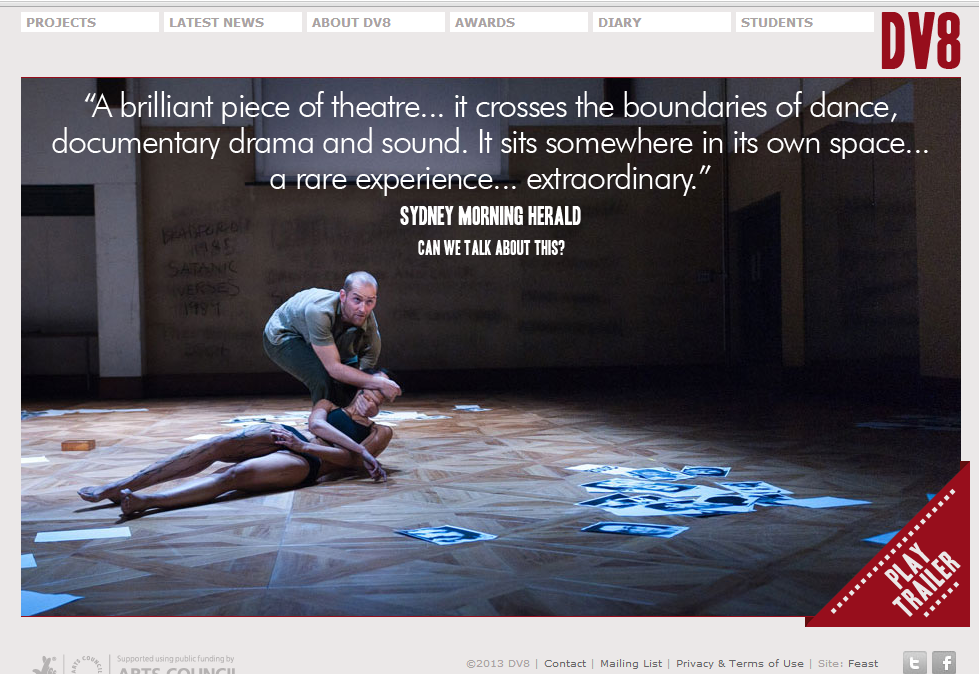
To design my page's, I wanted to browse various websites and see what appealed to me so I could carry these through onto our website. Our client told us he liked the 'dv8' physical theatre company website, so that was my first choice to go and pick ideas.
Strengths: it is very slick. Movement when clicking onto the first tab gives a professional feel to the website and the colours work well together. the tabs are visible at the top. The picture gives a good sense to the drama they associate themselves with, as well as being ambiguous making you click the trailer.
Weaknesses: although the colour scheme looks nice, could seem bland in juxtaposition to the kind of work that DV8 carry out. The name, or logo of the company isn't as established unless you previously know of the company as it's fairly small and doesn't stand out.
Opportunities: tabs allow the audience to navigate successfully and view more of the pages. Picture of engaging work will also grab the attention.
Threats: feels more like it's promoting one show than the theatre company itself.
I like the simplicity of the home page, it is actually a movement when you first go on the website and it transitions into this, although that works for this company, I think it's too advanced. I do like the quoting idea as it add's a touch of a professional and well viewed company. It is also linked to a 'trailer' which is enticing. I would like to include a video on the home page but maybe as a separate item to the pictures. There is a strong house style, which the group has already agreed to follow such as this website. We also noticed the link the twitter and facebook in the bottom corner, and thought that especially because our target audience is teenagers, that would also be a great feature to have.
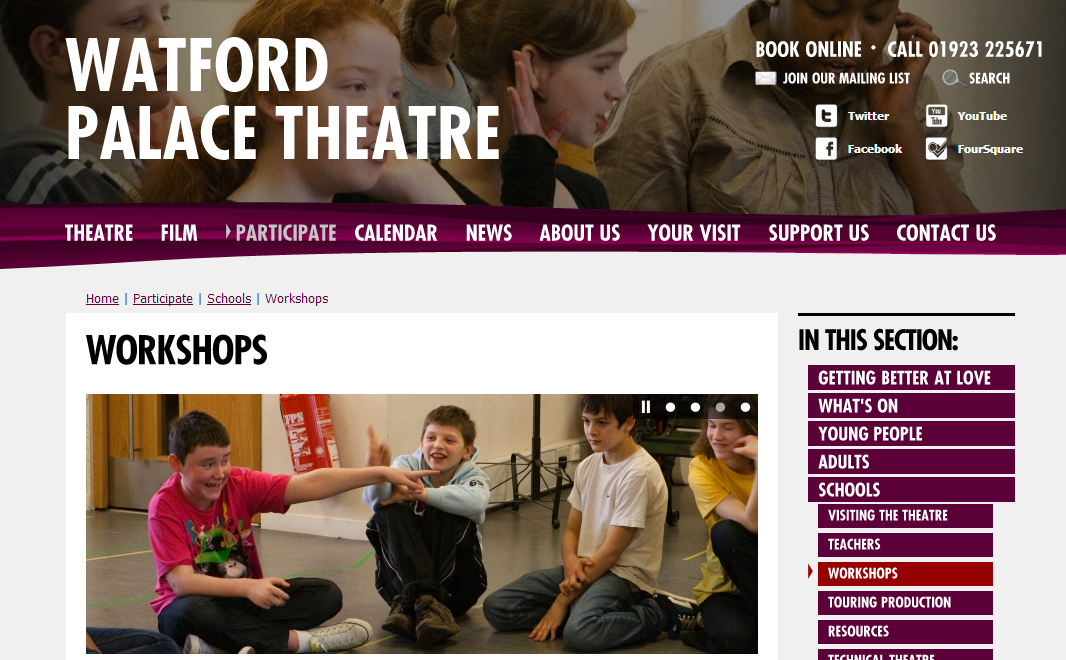
I decided to type in 'drama companies' and see what the top results would be. I chose the 'Watford Palace Theatre' as they do workshops with children which has some relevance to some work that N2C do.
Strengths: the slideshow presents happy children which sets a positive atmosphere for the company and what it stands for and the ages it targets. The tabs are clear so it's easy to navigate around the website.
Weaknesses: there are to navigation bars, one across the top and one down the side. Although this may seem helpful, it presents the audience with more options, and personally I find this confusing and too 'busy' looking.
Opportunities: it shows a wide variety of ways to participate as a young person in an engaging way. Threats: overcrowding of places to go/look may turn the audience away.
I like the bold use of colours, such as the contrasting red and purple, although I'm not sure that would fit with the colour scheme for N2C. I really like the slideshow idea and will work that into the home page of the website so add some movement and that way I can show the variety and versatility of the acting that N2C does from the homepage.
After establishing these roles and looking at other website's features, we did rough copies of how we wanted our sections to look like without the text. We then arranged a meeting with the client Mr Chipp to present the information.
After the approval of all sections of the website I had the outlines for what text I needed, and I just needed to create it. The only things I did not get to discuss with Mr Chipp was which past productions he would like to be mentioned, I decided the best way to get into contact with him was via email. This is that email with Mr Chipp's reply:
After this, I decided to create the text for the sexuality but we will not input it until post-unit. I was able to focus on the text necessary for the deadline and then decided to make a computer version on publisher of my pages in order to aid Matt when designing the website. But, as a group discussion, we have told Matt that if he finds issues with creating the design we put down for him, he can edit it to something as similar as he can in order to meet the deadline with a working website. Post-unit we will continue editing the website, enhancing it to reach the full potential.
I then needed to hand in to Matt the design plan with the text that fits in where on each for the past productions tab. We had a verbal discussion with the overall idea's that I wanted and we would try and achieve the closest possible, and then develop post-unit.
We have been commissioned to create a piece of drama for the charity 'War Child' to raise awareness of the conflict in Syria. The piece will be a Theatre in Education performance that we will tour around schools in Sheffield. The piece aims to raise the question 'what would you do if the child were at your door?' We are unsure whether it will be aimed for primary or secondary schools, so we have decided to aim it at secondary schools for the desired target audience, and then we can alter it to suit a change if necessary. We raise the problem that we don't do anything about the problem of children in war crime because it's not happening at our door, and therefore don't feel it is necessary.
We started off the lesson in the dark, stood in a space. We had to imagine a door of our choice, and then create a room in our head. My room had the basics of a bed, a desk, a chair and bedside table. It also had a door to the bathroom, but I didn't create that image. We then were told to get in pairs and discuss our layouts, and then alter so we knew were all our objects were in the room. We physically moved ourselves around the space so we had a spatial awareness of our shared we room.
Then, sir asked us to create a small scene where we were given the characters or journalist and photographer. We had to show sir through a small performance the layout of our room. To highlight objects in our room we.. -Got a drink from the bedside table
-Emily went into the bathroom
-I asked for where my papers were, which were in the desk
-I sat on the chair
-Emily went in the wardrobe
By labeling things and knowing ourselves where things would be, it helps to give the audience a clear idea on the room and they can begin to create the set in their own head. For the purpose of devising it was good to get a sense of what we both thought the room should look like and we could then have the starting setting sorted.
We then added character interactions - we were told the room was set as a hotel in Syria. We'd been creating a story for a few weeks and the room was damaged. We also had to incorporate the war zone that was happening outside the room. One idea that I had in my head was to make sure that the characters had a sense of history. So I added in lines such as 'where did you put my papers?' and 'do you want to use the bathroom first today?' to give an indication the relationship. Accusing of moving the papers creates a careless character for the photographer as well as tension between the two. We then decided that this bedroom would be the set for the entire piece. He removed one of the rooms and we discussed that with target audience of teenagers, we want to get them engaged by starting the performance with humor. We brainstormed idea's that we'd find funny such as: -ceiling falling in (we decided too impractical) -loud bang shocking the person (gives too much away) -toliet related -poo - not having any toliet paper. (We chose this) We then each split off and worked with our pairs to create a scene where one of the characters would walk in with the trousers around their ankles looking for toliet paper. This humor says something about the way they were living and also implies a lot about the relationship between the photographer and journalist. We each created our own conversations from this in our pairs and then performed them to each other. By doing this, we were given an opportunity to see what worked and what might not. By discussing the best bits from each others we decided on the best outcome scene possible. As we want the piece to stay focused on the serious topic of the conflict we didn't want to make the scene to long as it would be hard to get the audience on track for the serious discussions that are to follow. We set the dialogue as:
Journalist: Morning Photographer: Morning, good sleep? J: sure, what are you doing? P: looking for some toliet paper J: that's a magazine... P: erm yeh.. have you got anything more absorbent? J: well i've got my handkerchief but.. P: that'll be great, i've really gotta wipe J: sure (photographer leaves through the door with trousers still down) This short scene has the potential to engage the audience with the humor which will make them feel more comfortable with the cast as we are making the piece interactive. The fact that the photographer is looking for loo roll suggests that they have been there a while or have found it hard to have basic items so it subtly suggests facts that they're away from home and are somewhere that is not well off.
This way of devising allows us to consider a variety of idea's and collect the ones that work the best. It's a nice way of being flexible as we created the scenes very quickly and naturally so it was okay if some things didn't work because we blended all the best bits from each performance.
Two tower blocks were set out in front of us and as the group of 6 we were told to create 3 freeze frames.
1. Off the ground
2. All on the floor - with physical contact
3. On each level.
After create these three basic steps, we were told to put them together as smooth as we could, this meant adjusting which side we would face, but we kept the initial position, the outcome was this:
After doing this we were split into 2 groups: Matt, Emily and Alex. Me, Kelly and Chris.
We were then told to remake that movement in the group of 3.
After doing this we were shown a visual stimulus of an abandoned Chernobyl fairground, we then had to recreate that setting with ourselves, Matt stood in the middle recreating the hanging drape in the center, this added levels and a certain depth to the beginning. We then moved into the groups.
We then developed the three freeze frames to fit the story of the Chernobyl incident. To do this we assigned characters, I played the daughter and Chris and Kelly were the mother and father. We had an idea about them dragging me backwards to show the audience that the parents were going against the speech that we fitted. Adding the plastic bag gave a physical representation of the nuclear disaster and the effect. As the parents continue to have speech and they hold the bag behind my face it shows the guilt and responsibility they hold after sending the girl out to the fairground alone.
This turned out as this:
The overall effect meant we followed two stories. It was a unique performance because the original movement was not made to specifically fit the story, we adapted the basic movements in order to tell the story, in mine this was where Kelly dragged me back rather than pulling myself back. This is because it could resemble a foreshadowing action of what the mother wish she would've done and the guilt she would've felt. All the actions were very violent in juxtaposition to the words we put with it. This made it more unsettling to watch as well as leaving a lot of unanswered questions. This shows the success of this way of devising. When devising it can be hard to get a unique and interesting way to start a piece, starting away from the piece idea and focus on the movement then add dialogue gives a depth to the piece as there's more to watch as we focus on different meanings at different times.
After watching each others performances, Mr Chipp then set both groups to do a realistic scene following a character or couple of characters from the other groups performance.
Alex, Emily and Chris were following the story that myself, Kelly and Chris decided. They approached it from the aspect that I'd gone and not returned from the fair. They were awaiting news but there is now tension from the guilt and self blame on deciding to send her alone. This is when someone calls round to announce they've found the corpse.
I liked the way they connected with the characters we had left for them, and the naturalistic scene gives the audience a chance to connect with the atmosphere that's left. When the police/doctor comes round to say, you can (or should be able to) feel the atmosphere drop when the news of the found corpse is delivered This is because so far the information has been shown aggressively and the audience can relate to the confusion.
Kelly had to leave rehearsal so me and Chris decided to do a doctor meeting where Chris was playing the brother Alex. As the doctor I was giving Chris the bad news of his results. Here is the piece:
Creating this scene needed research onto the long term effects after the nuclear destruction took place. Finding out that Leukemia was very common afterwards we decided that would be the news. We make the audience feel uncomfortable when Chris questions the doctor because it's such a serious issue and instead of being upset, the character of Alex ends up getting angry and frustrated. The doctor, who if was working at this time would've been giving this news out very consistently throughout the day, we wanted to make it seem as if she was caring, but yet she still had other people to talk too about their results.
Creating a realistic scene after the more vague movement was a lot easier, because it can allow you to answer some of the questions from the first 'scene' and we also get a better connection with the characters. It also allows a variation in the performance style which can create a better and more engaging performance.